
Live agent sessions
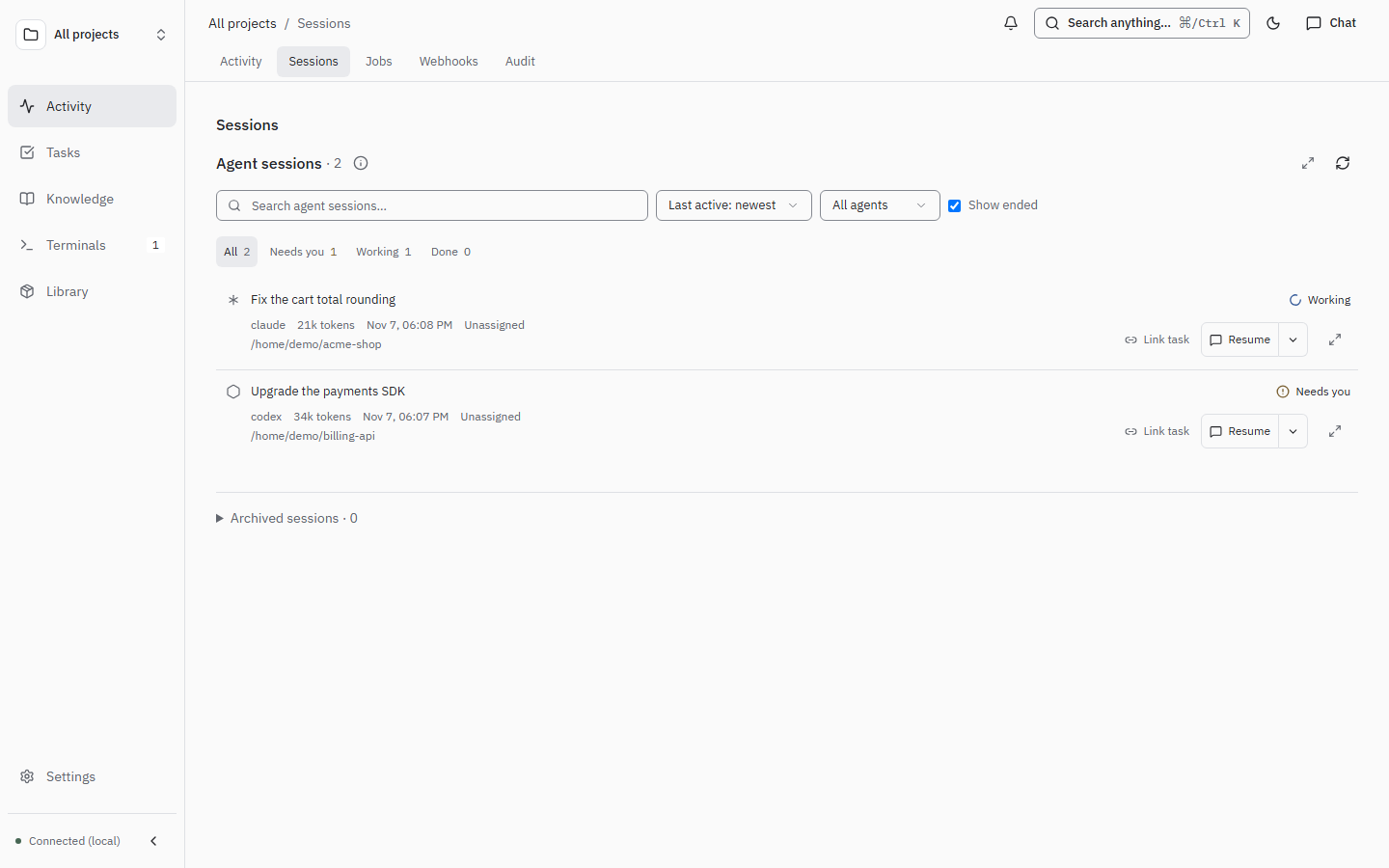
The chat page's session list and viewer use the same working, waiting and ended states, task links, search and conversation viewer for all agents. Waiting sessions stay in the active view; inactivity alone does not end a registered session.
Opening a chat verifies a stale Working claim before showing it: when the session has no native activity for 30 seconds, ORC re-checks the agent's own store and settles the row if the turn has ended, so an idle session does not pop the working panel. Returning to the tab re-checks it the same way. A claim with recent activity stays trusted and settles through the usual process and file watches.
A parent whose turn has ended but whose children still work does not read as idle. The status strip above the composer stays up and names the work in flight (Waiting on 2 subagents, or Running 1 command for detached commands), with a row per child that keeps its own clock and opens or stops that child. Spawned chat sessions and the provider's own native subagents both count, and the rows come from live session state, not the finished turn's transcript. The session list rolls the same truth up: the parent reads Working while a child holds a turn and Needs you when a child waits for a human, while its own status stays idle so a new message still starts a turn immediately. Stop shows Stopping… until the agent actually ends the turn, rather than flipping to idle on the request.
Opening a linked task keeps you on that task even while a session search is updating.
Sessions without a title use a readable folder name, including Windows extended paths, network shares, file URLs and POSIX paths. For example, \\?\C:\Projects\orc displays as orc rather than the full path in session and notification titles. Named sessions keep their titles; execution uses the original folder path. Codex uses the first prompt when its native title is only the folder. Claude Code sessions use the conversation title Claude writes (or your /rename), then the first prompt; the <folder>-<hex> name Claude Code gives its process is never used, so each /clear in one terminal is its own row with its own title, and a conversation with no prompt yet reads New session. Recency comes from the last message, not from the transcript file's modification time.
Subagents show inside the parent's chat, under the turn that started them, as a tree collapsed to one summary line (3 subagents · 1 failed): Claude Code subagents (their .meta.json description is the title, parentAgentId nests a subagent under the one that spawned it), Codex spawned threads, Cursor subagent composers and OpenCode child sessions, at any depth. Each row shows the subagent's title and state, and a branch with a failed or waiting subagent reads Needs you; pressing a row opens the subagent's own chat, whose header back arrow names the parent and returns to it. A call is matched to its subagent by the id each agent records (Claude toolUseId, Codex SubAgentActivity, OpenCode task metadata); Cursor records none, so its subagents match calls in start order. Subagents are not listed in the session list, but a parent row still takes the most urgent subagent state (a failed subagent at any depth marks it Needs you) and matches a search for a subagent's title. Subagents do not raise notifications of their own. Cursor IDE chats take their folder from the workspace that holds them, and a transcript whose worktree was deleted falls back to the deepest folder that still exists.
Independent sessions nest in the session list under the session that started them: a session started through ORC's session spawn tool (any agent) and a Claude Desktop session started with start_session, read from spawnedFrom in the Desktop session files. They form a tree, so a spawned session that starts more shows them under itself, and the parent row counts them as N sessions. A spawned session keeps its own notifications and usage.
The list shows only sessions that can be opened. An ended Claude, Codex, Gemini or Pi session leaves it when its transcript file is gone, including a session that ended before any prompt was sent, and returns when the file comes back. A task's session list keeps its linked sessions either way. A Codex rollout compressed in place (.jsonl.zst) stays listed and opens as before. Codex's own review and approval runs are not listed. Titles skip slash-command and IDE wrappers and terminal color codes, and a Cursor chat whose title was never generated is named from its first message or folder.
Choosing a session never changes the project filter in the header: All projects stays on All projects. A session whose project no longer exists groups by its folder, and folders that share a name show as much of the path as tells them apart.
Rename, hide and fork
A session's viewer, Rename, stores your name on the ORC row. The agent's title still updates underneath, and Use agent title in the rename dialog drops the override, so a re-sync never resurrects a name you removed. Hide keeps the session and its transcript and only removes it from the default list; the hidden toggle above the list brings hidden rows back with a Hidden label, and Show in list in the viewer restores one. Both survive a restart and a session re-sync. Hiding does not mute notifications, tasks or terminals that already point at the session.
Fork in terminal (in the resume actions on Activity, terminal sessions and task session rows) starts a new native session from the session's history when the agent CLI supports it: Claude runs claude --resume <id> --fork-session and Pi runs pi --fork <id>. The fork is a new terminal and a new session row, and the original conversation is not touched. Codex, Cursor, Gemini, OpenCode and agents without a CLI fork do not offer the action; fork those conversations from an assistant response in chat instead, which uses the agent's native session fork or a bounded context replay.
Send to host… (the send icon in the same resume actions) moves a Claude Code, Codex, OpenCode or Pi session to another ORC installation saved under Settings → Hosts: pick the server and one of its projects, optionally leave a note, and send. The source snapshots the repository (secret-looking files stay local), pushes it to the shared Git remote and uploads the conversation; the destination shows the session as Ready to resume and the source row keeps a Sent to … badge with a link back to the send result. The first resumed turn carries a handoff briefing so the agent knows it changed machines. Both installations must reach the same Git remote, and the session must run on the source server's own machine. Details: Session handoff.
Activity and full-width session history share compact title/provider/state rows. An ORC terminal agent without observed session activity shows Unknown, rather than assuming it is idle. A session's working folder decides its project: the most specific project folder wins, and a worktree resolves to its shared checkout even when it lives outside the project's folder. Opening a session from the session list adopts its project in the workspace header, so the session list and notification inbox follow the project you are actually working in. The mapping is re-evaluated when project folders change, and live sessions and their notifications move with them; a session whose project folder was moved away stops claiming the old project. Each project has one folder scope. Worktrees resolve to their shared checkout, and a project without a scope takes the repository roots of its known sessions as derived folders, so no second folder list is stored. OpenCode's session store is watched alongside the other agent stores, so its new sessions appear without waiting for another agent's activity.
Open a Codex or Claude session's viewer to see its last reported cached-input percentage. Expand the cache indicator for input, cached reads, cache writes when reported, and recorded session totals. Cached input is a share of input tokens, not output or total billed cost. Claude input includes uncached input plus cache reads and writes; Codex reports input with its cache reads already included. Claude totals deduplicate repeated messages; Codex totals use the provider's cumulative snapshot.
When Claude records a cache-write lifetime and activity timestamp, the indicator can change to Cache may need rebuilding after that lifetime has elapsed since the recorded activity. This is a conservative hint, not an exact expiry or a guarantee about the next request: request generation time, prompt changes and other requests can affect reuse. Missing cache metrics or timing are omitted; there is no expiry-unavailable message. Codex does not currently provide timing evidence here. Other backends omit the indicator until native cache metrics are supported. Metrics refresh when ORC records new usage for the session; opening an ended session reads its recorded data once.

Codex uses its native writer locks and latest turn status. A held lock identifies an open session; a completed turn is waiting, and a turn in progress is working. A released lock ends the session. Older Codex versions without a writer-lock directory retain the legacy activity fallback.
Cursor IDE history, Cursor CLI (agent / cursor-agent) history and Gemini conversations are discovered separately. CLI and IDE Cursor histories are separate stores: neither can continue in chat, and only Cursor CLI records offer a CLI resume command. Their viewer stays read-only and says so. Gemini keeps Continue in chat, and Copy resume command appears in the viewer for Claude, Codex, Gemini, OpenCode, Pi and Cursor CLI.
OpenCode sessions are read from its SQLite store ($XDG_DATA_HOME/opencode/opencode.db, default ~/.local/share/opencode/opencode.db) on the local machine or the selected SSH host. Top-level sessions appear with their folder, title and token count; the conversation viewer shows messages, reasoning and tool calls with their output. OpenCode has no lifecycle hooks, so its sessions are listed as ended. Continue in chat imports its transcript and continues the same session in chat; Copy resume command offers opencode --session <id> for a terminal.
Pi 1.5.2+ sessions are discovered from the native ~/.pi/agent/sessions JSONL store on the selected execution host. Absolute PI_CODING_AGENT_DIR paths in Pi provider environment settings (and the local server environment) are also scanned under their sessions directory. The viewer follows the active branch and context edits and shows text, reasoning, tool calls/results and image placeholders. Native names and recorded token totals are retained. A Pi session open with the @orc/pi package shows as running or idle with its process id, ORC refuses session messages for it until Pi exits, and chat turns while it runs a turn. Without the package, Pi sessions appear as ended; close the native Pi conversation before resuming it in ORC to avoid concurrent writers.
Resume in chat imports the visible history and continues the original Pi UUID in its original folder and execution host. It uses the enabled default Pi provider, the enabled built-in Pi provider, or the sole enabled Pi provider, in that order. If several named Pi providers are enabled, choose the intended one as the default first. Native history is not replayed as a new prompt. The viewer's copied resume command uses pi --session <uuid>. Custom --session-dir stores outside these directories, older session formats, cross-host handoff and embedding/archive ingestion are not supported for Pi.
A Claude permission prompt, Claude question, or Gemini tool-permission prompt sets that session to Waiting for you within a few seconds of the hook firing. ORC sends one browser push on the attention topic for that transition. Answering the prompt, or the turn ending, clears the flag. A session that stays waiting does not send another push. Codex questions continue to come from its transcript. An OpenCode session with an open question shows Waiting for you from its database, including sessions started outside ORC. Codex and OpenCode approval prompts are not written to disk, so a discovered session waiting on one is not flagged. Cursor's installed hooks do not include a permission event, so Cursor waits are unchanged.
Lifecycle hooks are a choice, per agent. Install the native adapter into the settings file you pick — the same explicit install also enables agent rules:
orc rules install-hook claude --target ~/.claude/settings.json
orc rules install-hook cursor --target ~/.cursor/hooks.json
orc rules install-hook gemini --target ~/.gemini/settings.json
The installer preserves existing hook entries and other settings and writes a dated backup. Nothing is installed globally or automatically; each agent is a separate decision, and --events can narrow the listeners. New/resumed sessions register their owner PID in ~/.orc/live-sessions/. Start, prompt, response, tool and stop hooks update the shared state; session-end hooks and dead owner processes end it. Existing sessions may need to resume or reload hooks once before they register. Hook-captured conversations begin when hooks are installed; old native history is retained when its transcript exists.
Hooks need the orc executable on the installation machine. They run a bounded owner lookup, write private local registry/transcript files, and never grant tool permissions or inject prompts. Native agent transcripts remain read-only. Full prompt/tool content belongs to the local conversation history and is not sent to external services by these hooks.
Other local agents can use LiveRegistration, readRegistrations and writeRegistration from @orc/core/live-session to participate in the same PID-backed lifecycle. Native discovery/resume commands still require a supported adapter; the dashboard automatically includes registered backend names in its filter.
Sending a message to a session
Open a session and use Send message to queue a note for it. ORC delivers queued notes at the session's next safe point: before a tool call, at a prompt submit or stop hook, or when the agent reports session start. For an ended session, ORC resumes it with a bounded turn. Messages wait in a compact queue you can reorder or cancel until delivery starts. A delivered message records whether it arrived through a native hook (hook), an ORC chat turn (chat), a resume (resume) or native steering into a running chat turn (steer).
Live sessions of agents without a context-capable hook (for example Cursor or OpenCode) cannot receive a message while they are running; queue it after the session ends. Claude, Codex and Gemini sessions accept messages through their installed hooks and the ORC-managed Claude SDK hook.
Delivery is not approval. ORC tells the recipient the message came from another session or a human relay, that it cannot approve a tool, permission, plan or configuration change, and that configuration must be changed by a human. An agent-to-agent message chain ends after three hops, and one agent session may queue at most 20 messages per target in a rolling hour. Pass a stable request_id when retrying the same send. Messages still delivering when ORC restarts become interrupted and are never retried; queued messages remain queued.
The same queue is available to agents through the session_send MCP tool (bind the connection with ?session=<session id> or run stdio MCP inside the agent) and to chat channels with /send <session id> <message>.
/send                  list live sessions
/send <id>            choose a target
/send <id> Fix the failing test
Delegating to other sessions
An agent can start and drive other sessions, the way Claude Code drives its subagents:
| MCP tool | Does |
|---|---|
session_start | Starts a headless ORC chat with a prompt and returns its session_id immediately |
session_send | Messages it: queue, steer or interrupt |
session_status / session_list | Status (queued, running, waiting, idle, failed, stopped), last reply, queue, parent and children |
session_wait | Blocks until it stops running, waits for a human, or replies (until: message); session_ids with mode: all or any waits on several children |
session_stop | Stops its current turn and, by default (cascade), every session it started; queued children are cancelled; messages still queued for a stopped session are cancelled, and messages sent after the stop deliver normally; sessions stay resumable |
session_start takes workspace:
workspace | Same project | Another project (project) |
|---|---|---|
same (default) | The caller's folder, sharing uncommitted edits | Refused |
worktree | A new git worktree under .orc/worktrees/ on a new branch cut from the caller's committed HEAD (uncommitted edits stay behind) | A new worktree of that project's checkout |
project | The project's main checkout | That project's main checkout |
Another project must be inside the caller's MCP project scope.
When all four chat workers are busy, session_start still returns at once: the child is queued and starts when a worker frees, even across an ORC restart.
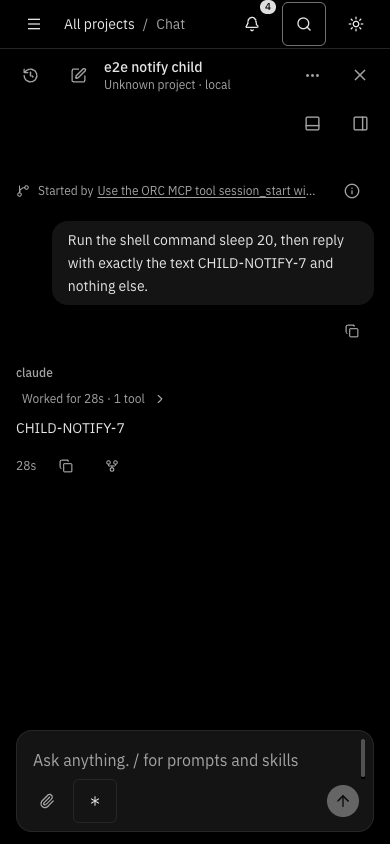
With notify (default on), ORC tells the parent when the child finishes, fails, is stopped or waits for a human. If the parent is mid-turn on an agent with native steering (Claude through the Agent SDK, Pi, Codex) the note is steered into that turn; otherwise it is queued for the parent's next safe point, or starts the parent's next chat turn when it is idle. Each note starts with a header line, [orc child-session id=<id> outcome=<outcome>], so the parent can tell it from human text. The same delivery path carries human messages and channel relays.
Guardrails:
- Only a session's parent, or an ancestor of the parent, can
steer,interruptor stop it. Any other session can onlyqueue. - A child inherits its parent chat's permission mode, agent options and tool allowlist; a child of any other session starts in the default permission mode. A child's permission prompt or question goes to a human, never to the parent.
- A child's notifications to its parent count toward the 20-messages-per-hour cap for that pair.
- A chain of started sessions stops at three levels, and a session can start at most ten sessions an hour.
Chat and the session detail show the lineage: Started by links the parent, and Started N sessions lists the children, including the worker sessions of tasks the agent created with task_create.

Following background work in chat
A conversation can keep working after its last message. Detached commands and child sessions show up over the composer, so a quiet transcript does not read as a stuck one:
- A tool call that starts detached work — a command or a subagent run in the background — is marked from its own input, so it works the same for every agent that can detach work.
- A running, queued or waiting child session appears as a row with Open (switch to its chat) and Stop (stop it and the sessions it started). Rows come from live session state — both sessions the chat spawned and the provider's own native subagents — follow the child's real status and clear when it settles.
- Each row keeps its own clock. One job reads as a single line; several fold into one summary row that expands to the full list. While the parent's turn has ended but children still work, the strip header reads Waiting on N subagents with a running timer instead of going quiet.
- The session list rolls the same truth up: a parent reads Working while a child holds a turn and Needs you when a child waits for a human, while its own status stays idle so a new message starts a turn immediately.
- Detached tool rows come from the agent's latest turn and clear when the agent replies again: a backend that never reports a background command's exit cannot be checked, so ORC does not keep claiming it is running.
- In a chat ORC runs, the agent reports its subagents live and the turn's tree shows each one's status, tokens and duration as it works: Claude from its
task_started/task_progress/task_notificationevents (nested byparent_task_id), Codex fromsubAgentActivityitems and each child thread's token usage, OpenCode from itstasktool calls (and from child-session updates when the agent streams them, nested byparentID). A subagent waiting on a permission prompt reads Needs you, and so does the chat while a subagent in its latest turn failed or waits. Running subagents also show over the composer. - A Claude turn stays open while a subagent it started in the background still runs, because ending the turn would stop it; the agent's follow-up reply lands in the same turn. Pi and the ACPX agents report no subagents, so nothing is shown, and Capabilities in the conversation details lists Subagents only for agents that report them.